
-

Free transport
-

24/7 security
-

Lowest price
-

Rent from one week
-
Free transport
-
24/7 security
-
Lowest price
-
Rent from one week
This is how to store your water sports equipment while preserving its value!
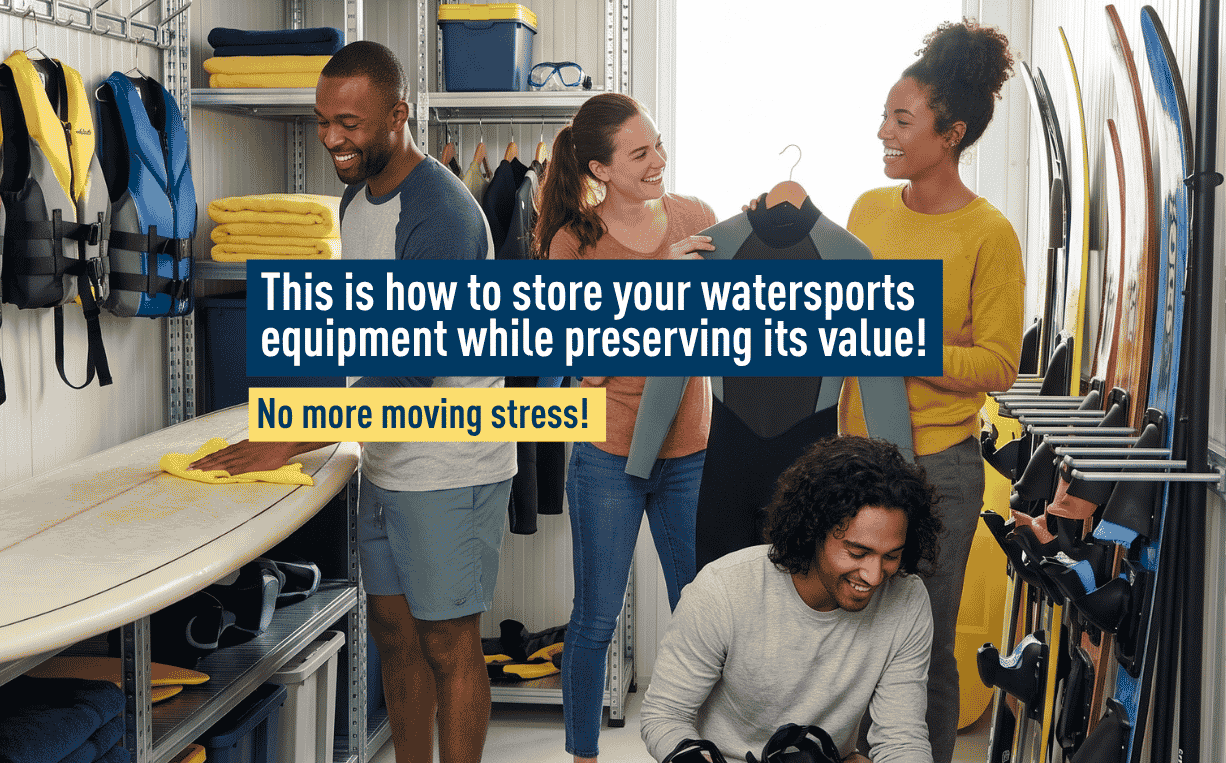 Tips for cleanup and storage
The summer season has come to an end. Unfortunately, it is now simply too cold to stay active on the water. Are you a passionate water sports enthusiast? You probably will not use your diving gear, surfboard, water skis and other water sports equipment for the next six months.
Because this equipment can be quite expensive, it is important to store it carefully. Proper storage will help your water sports equipment last much longer. However, storing everything properly requires quite a lot of space. In this blog, you will discover how to store your water sports equipment in three simple steps.
Step 1: Research the best storage conditions for your water sports equipment
The first step is to research the best storage conditions for your water sports equipment. These are valuable items that require proper care. Below, you will find a useful checklist of important factors to consider:
Moisture and ventilation: High humidity and poor ventilation can seriously damage your equipment. Cold and moisture can cause certain materials to expand. Always choose a well-ventilated, climate-controlled storage space.
Ultraviolet radiation: Rubber wetsuits are sensitive to UV radiation, which is still present on cloudy days. Keep your water sports equipment away from direct and indirect sunlight.
Pests: Mice are attracted to fleece materials. A fleece undersuit may therefore become an easy target if mice can enter the room where your equipment is stored.
Space: A wetsuit will remain in good condition for longer if it is not folded tightly or rolled up. Leaving a wetsuit folded for an extended period can cause permanent creases and thin areas. These weakened areas may eventually turn into holes, meaning you will have to replace your wetsuit.
Step 2: Decide where to store your water sports equipment
The second step is deciding where you are going to store your water sports equipment. A shed or garage may seem like a suitable location, but it is important to keep the conditions mentioned above in mind.
A damp shed or garage can be extremely damaging to your wakeboard and other equipment. Storing your water sports equipment inside your home may be safer, but it also means that you cannot use that space for other purposes.
Another suitable solution is to keep your diving gear, surfing equipment and other items in an external storage unit. At ALLSAFE Mini Storage, you can rent affordable seasonal storage. Our storage units are climate-controlled and well ventilated, helping your equipment last longer without taking up valuable space at home.
Do you also have a boat that needs to be stored outside the sailing season? At ALLSAFE, you can store your boat in a secure outdoor storage area. Prices start from €90 per month, with 24/7 camera surveillance and flexible weekly cancellation.
Step 3: Use your surfboard and diving gear as home décor
Have you decided to store your water sports equipment at home? You can also use it to add character to your interior.
Bring the beach into your home by using your surfboard as a decorative feature. You can place it against a wall or use an attractive surfboard wall-mounting system. This way, it will always feel like summer inside.
Another fun and natural-looking option is to use a thick rope. Create large loops, attach them securely to the ceiling and use them to hang your surfboard or wakeboard.
You can also display your diving equipment in a glass cabinet. Your regulator, gloves, fins and diving mask can make an unusual and eye-catching display. As these are not items that everyone sees every day, they can also become great conversation starters. Just make sure that all your water sports equipment is completely dry before storing or displaying it.
By following these three steps, you can continue enjoying your diving and surfing equipment for many years. Do you have any useful storage tips to share? Let us know in the comments below!
Related articles

How to Store Your Shoe Collection Neatly and Stylishly
People, particularly women, own an average of seventeen pairs of...

Space at home creates peace of mind: here’s how to easily create more room!
Do you often feel stressed at home without knowing why? There is...
3 Easy Steps and Tips to Declutter Your Home!
Around 80% of the items in your cupboards remain untouched fo...