• Free transport

    Free transport

  • 24/7 security

    24/7 security

  • Lowest price

    Lowest price

  • Rent from one week

    Rent from one week

  • Free transport

    Free transport

  • 24/7 security

    24/7 security

  • Lowest price

    Lowest price

  • Rent from one week

    Rent from one week

Laying your own floor – this is how you do it!
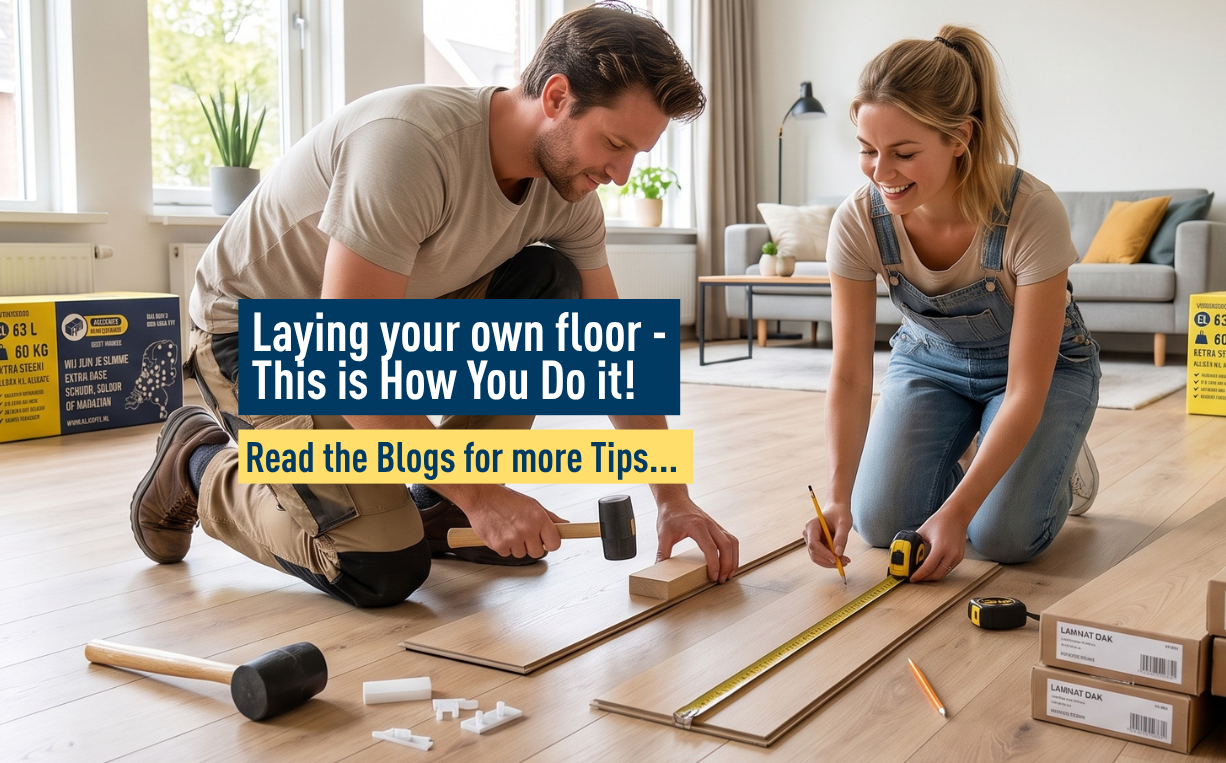
13 August 2026 By janice Reading time: 4 minutes
Laying your own floor – this is how you do it! Moving tips

Laying your own floor – this is how you do it!

A new floor can give your home a whole new look. It is a job you can outsource, but it is also very doable to carry out yourself. Will you choose laminate, PVC, or perhaps real wood? And what possibilities do your floor’s skirting boards offer? We’ll give you a few tips so you can lay your new floor easily and successfully!

Types of flooring – which floor is ideal for you?

At the very beginning, you immediately face an important choice. What kind of floor do you want to have? We have listed a number of options and features for you:
  • Floor tiles: Often used in bathrooms and kitchens. Applicable everywhere and easy to lay, but not portable because you glue the floor tiles down.
  • Carpet: Often used in the living room or bedroom. Carpet flooring is easy to move/replace and especially warm underfoot in winter. Instead of laying it in one piece, you can also opt for carpet tiles.
  • Laminate: Easy to lay with a click system and easy to maintain. Laminate is often affordably priced, but it is susceptible to moisture.
  • PVC: Moisture-resistant and durable. PVC is easier than laminate because you don’t have to saw (trimming can be done with a sharp knife or scissors), but harder than laminate because you often need to level the floor first.
  • Wood: Wooden floors are durable and beautiful. The downside is that your finish is permanent once you fix the floor in place, and it can start creaking if you let it “float” (meaning not gluing or nailing it down).

Laying laminate versus laying PVC

We will compare two of these flooring types in a bit more detail because the choice often proves to be difficult. This concerns laminate and PVC flooring:
When looking at the higher-end options, both types of flooring don’t differ much in price. However, starting prices for laminate are lower. For your bathroom, it is best to use PVC because it handles moisture much better than a laminate floor. Laminate can start bubbling with too much contact with water, and you definitely don’t want that!
Would you like to have underfloor heating in your bathroom (or another room)? Then definitely go for PVC. This conducts heat best, allowing you to potentially use the underfloor heating as your primary heat source. That means you won’t need an additional heater! Furthermore, PVC lasts a lot longer than laminate: it is virtually wear-resistant.
If you still prefer laminate, that can obviously be a great choice too. However, there is a good reason why PVC has gained ground compared to laminate in recent years. It’s up to you!

Underlayment and skirting boards

When laying a floor, you must keep in mind that the subfloor needs to be and stay dry. In an existing house, this usually won’t be a problem, but in a new-build house, you should calculate about two months of drying time for a new concrete floor. If in doubt, you can have the moisture level measured by a professional. Just to be safe! Also pay attention to the thickness of the underlayment. When living in an apartment, there are often mandatory minimum underlayment thicknesses to limit noise nuisance for your neighbours.
To finish off your floor, it’s best to always install skirting boards. These ensure that your floor and walls blend together nicely. Skirting boards come in all shapes and sizes. What you want in your home depends heavily on your personal taste. For example, you can choose between tall skirting boards or low ones. You also have the choice between a sharp or subtle contrast with your wall and floor. To make your skirting boards functional and even more attractive, you can do much more. For instance, you can run cabling behind your skirting boards and install (or have installed) small lights into them. Sounds like a nice idea for you?

Make space for laying your floor

You need space to lay a floor. It is most convenient to lay your floor (at least room by room) in one go. If you have a lot of items lying around, or if your things are in the way in another room, it might be handy to store your belongings elsewhere (temporarily). You can do this at ALLSAFE Mini Storage. Here your belongings are kept safe and heated, giving you the time to finish your project properly! Want to store some items longer? That is also possible! You rent the space you need for as long as you want.

Tips for laying your floor

There are a few things you should take into account in advance before laying the floor:
  • Buy extra stock: It is wiser to buy extra materials. You can often return unopened packaging within 30 days.
  • Plank widths: When purchasing your floorboards, you can choose uniform or varying widths. Varying widths can create a surprising and playful effect.
  • Knee pads: Remember to buy knee pads beforehand to make the installation a lot more comfortable!
  • Acclimatisation: If it concerns wood, try to bring your floorboards into your home 2 weeks in advance: wood needs time to acclimatise and can still expand or contract.

Laying direction

When laying laminate or wood, it is also important to think about the laying direction. If the room is very long and narrow, it is better to lay the floorboards widthwise. This makes the space look wider. The same goes the other way around: if the room is short and wide, you can optically lengthen it by laying the laminate or wood lengthwise.

Enjoy your refreshed home

With your new floor, your house will look like it has undergone a true transformation. You can now put your furniture back (or have it put back) and perhaps immediately opt for a new layout. Always fun to do every once in a while!

Related articles

New Build or Existing Home – What to Consider When Buying a House
Moving tips
Reading time: 4 minutes

New Build or Existing Home – What to Consider When Buying a House

Temporary Storage for Your Belongings With both new builds and existing homes, you ... Continue reading
4 Tips for Moving In Together
Moving tips
Reading time: 4 minutes

4 Tips for Moving In Together

4. Decide What to Do With Duplicate Belongings Moving in together of... Continue reading

Selling Your House: 10 Tips to Make Your Home More Appealing
Moving tips
Reading time: 4 minutes

Selling Your House: 10 Tips to Make Your Home More Appealing

7. Let in Plenty of Light Natural light makes your home feel m... Continue reading